Visualizzazione post con etichetta European Parliament. Mostra tutti i post

English will not be an official EU language after Brexit, says senior MEP

No other EU country has English as their official language and so it could lose its status.

Danuta Hübner, the head of the European Parliament’s Constitutional Affairs Committee (AFCO), warned Monday that English will not be one of the European Union’s official languages after Britain leaves the EU.

English is one of the EU’s 24 official languages because the U.K. identified it as its own official language, Hübner said. But as soon as Britain completes the process to leave the EU, English could lose its status.

“We have a regulation … where every EU country has the right to notify one official language,” Hübner said. “The Irish have notified Gaelic, and the Maltese have notified Maltese, so you have only the U.K. notifying English.”

“If we don’t have the U.K., we don’t have English,” Hübner said.

English is one of the working languages in the European institutions, Hübner said, adding: “It’s actually the dominating language,” the one most frequently used by EU civil servants.

The regulation listing official languages of the EU would have to be changed unanimously by remaining countries if they want to keep English as an official language, Hübner said.

However, an EU source explained that the regulations governing official languages are themselves subject to more than one translation. The 1958 regulation regarding the official languages of the EU, which was originally written in French, does not say clearly whether a member country – Ireland or Malta for instance — can have more than one official language, an EU source said. Interpretations of the French wording tend to conclude that this might be possible, whereas the English version appears to rule this out.
________________________________
http://www.politico.eu/article/english-will-not-be-an-official-eu-language-after-brexit-senior-mep/
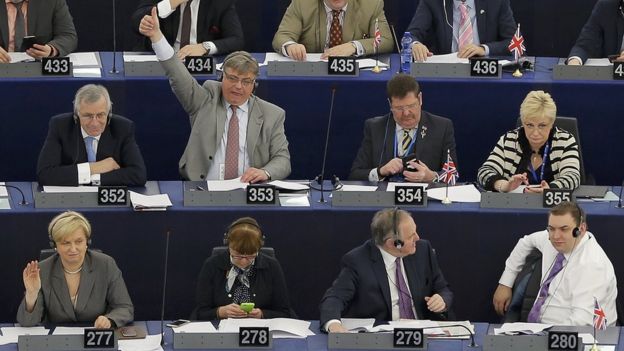
Fast-talking MEPs urged to slow down for interpreters

The European Parliament's chief of staff has urged MEPs to speak slower and stick to their native language, to help the interpreters.
MEPs in Strasbourg, 2 Feb 16
Secretary General Klaus Welle said: "It's extremely important that people do not speak too fast." Interpreters had made that request, he added.

Thousands of interpreters and translators work in EU institutions, to cope with 24 official languages.
The parliament has about 330 staff interpreters and 1,800 freelancers.
In addition, the parliament employs about 700 translators, who translate more than 100,000 pages each month.
The most recent languages to be made official were Croatian (in 2013), Irish, Bulgarian and Romanian (all in 2007).

Image copyrigInterpreters translate orally, in real time. But Mr Welle said some were overburdened and others under-employed.

"The average amount of time in the interpreter's booth is 10 hours... But we need more fairness between interpreters - the individual tally varies between six and 16 hours in the booth," Mr Welle said.
The scope of translation work in the EU was unique, he said. "Even at the UN you only have interpretation in six languages."
"It's also extremely important for interpreters that people speak their own language," he told the parliament's budgetary control committee.
"If they speak a foreign language the quality of interpretation goes down. You hear interpreters making requests to you: 'Please speak more slowly, speak your own language.'"
The parliament's budget for interpreters is €45m and another €9m for translations done externally.
The European Commission - where EU laws are drafted - has 600 staff interpreters and 3,000 freelance interpreters. The Commission's total staff is about 33,000.
________________________
http://www.bbc.com/news/world-europe-35501198