Visualizzazione post con etichetta report. Mostra tutti i post

More of us need to say 'nǐ hǎo' to Mandarin Chinese

Languages are crucial for work and life in the global race, and Mandarin Chinese is one of the front-runners, says Vicky Gough.

At the end of last month, George Osborne vowed to invest £10 million in UK schools so that more pupils can learn Mandarin Chinese, just like his daughter, Liberty.
But should we really be encouraging more of our young people to say ‘nǐ hǎo’ (‘hello’) to Chinese? ‘Shì de’ (yes), we should!
The reality is that languages, in general, are crucial for work and life in the global race, and Mandarin Chinese is one of the frontrunners. Not only is it already spoken by more than a billion people worldwide, but China is recognised as the world’s second biggest economy with many expecting it to wrest the top spot from the US by 2050.
If knowing the local language is the tangible tool that provides a vital understanding of local culture – and therefore essential business etiquette in a country such as China – it really can be the ice-breaker for those looking to trade or indeed clinch that high-flying job in a competitive marketplace.
But despite all the signs seemingly pointing in Mandarin’s direction, this year’s official GCSE statistics indicated that only 3,710 students took a GCSE in Mandarin Chinese in comparison to 157,699 who took French and 90,782 students who took Spanish.
The Chancellor is on a five-day visit to China
Moreover, research for the British Council in 2013 highlighted that only 1 per cent of UK adults can speak Chinese even though that same study revealed Mandarin to be the second most vital language for the UK’s future.
So, if it truly is the case that Mandarin Chinese is more and more important for the UK’s place in the world and China is becoming more and more important on the global stage, does something need to change and if so, how do we do it?
While the overall number of UK school pupils learning Chinese is still low when compared to other important languages like French, German and Spanish, there are promising signs of growth – a striking contrast to the drop most of the other languages suffered this year.
The number of entries to Mandarin Chinese at GCSE level in fact grew by a mammoth 18 per cent over the past year – a hugely encouraging statistic in itself but particularly when read alongside the rather more dismal picture of an overall decline of 4.65 per cent in language exams across the board.
A Mandarin class at Harris Academy, South Norwood
That said, it cannot be denied that, on the whole, we still have a way to go when it comes to boosting language learning in the UK, particularly if we want to ensure that less common but important languages such as Mandarin Chinese become a realistic choice for a critical mass of head teachers and their pupils.
With teacher supply being identified as the most pressing issue for teaching Mandarin in the UK, it is fantastic to see investment in this area and policymakers, educators, businesses and organisations continuing to pull together in this respect, but more needs to be done.
"It cannot be denied that, on the whole, we still have a way to go when it comes to boosting language learning in the UK."
At the British Council, we already have lots of ways that schools can help encourage language learning, including Mandarin Chinese, amongst their pupils, whether it’s through employing a foreign language assistant, partnering with a school in another country or taking on a challenge such as our annual British Council/HSBC Mandarin Speaking Competition.
Let’s do whatever we can to ensure that more of our young people realise the benefits that learning Mandarin Chinese can bring and that more of ourschools are able to realistically make this a language of choice for their pupils.
Vicky Gough, schools adviser at the British Council
___________________________________
http://www.telegraph.co.uk/education/educationopinion/11912898/More-of-us-need-to-say-n-ho-to-Mandarin-Chinese.html

Portuguese: the world's seventh most spoken language

Portuguese is not just spoken in Portugal, but in Brazil and several African nations including Mozambique and Angola. It’s also one of ten languages identified as most important for the UK’s future by the British Council’s Languages for the Future report. In the seventh of our series, Paula Boyce, who’s lived in Rio de Janeiro for over two decades, examines Portuguese.

Portuguese is pronounced differently in Brazil and Portugal
Just as there are differences between American English and British English, there are differences between Brazilian Portuguese and Portuguese from Portugal. Some words are different and could on some occasions cause confusion. For example, if you came to Brazil and asked to buy a camisola de futebol (a football shirt in Portugal) for your boyfriend, husband or brother, you might get some strange looks, as here in Brazil camisola de futebol means ‘football nightdress’. In Brazil, if you need to go to the toilet, you’ll ask to go to the banheiro. But if you request a banheiro in Portugal, you’ll be pointed in the direction of a life guard.
There are also some differences in grammar, such as different positions of pronouns and the Portuguese use of the vós pronoun, which doesn’t exist in Brazil. However, the main difference that leads to communication issues, as I discovered when I visited Portugal a few years ago, is pronunciation. I had already lived in Brazil for about 15 years, so I didn’t anticipate any problems with language – but how wrong I was.
The main difference is that the Portuguese ‘swallow’ their vowels, while the Brazilians ‘stretch’ them. In Portugal, a phrase as simple as Quer cafe? (meaning ‘Do you want coffee?’) sounded something like ‘kicaf’ to me. This led to a complete breakdown in communication, and a lot of frustration. On many occasions, people preferred to resort to English when talking to me. It was quite depressing, as until then I’d thought I could consider myself fluent in Portuguese. I was only comforted when I realised that the same thing was happening with my kids, whose first language is Portuguese!
Portuguese and Spanish are very similar languages
Portuguese and Spanish are closely related, as they are both Latin-based languages and share many grammatical structures and patterns. When I came to Brazil, I had already studied languages at university and spoke Spanish, and I found my knowledge of Spanish helped enormously. Very quickly, I was able to spot the similarities between the languages and create Portuguese words from my knowledge of Spanish, with, of course, a few embarrassing mistakes along the way.
Just one incident I can remember was when I was trying to write a cheque, and was unsure if the word quarto (‘four’) was spelled with a q or a c. I decided to check and asked in my best Portuguese, ‘Do you write the word quarto (four) with a q?’ At least, that is what I meant to say. Only when the shop assistant replied, smiling, ‘It’s better to use a pen’ did I realise that when you pronounce the letter q in Spanish, it means something very different in Portuguese. I had inadvertently ended up saying: ‘Do you write ‘four’ with your arse?’!
However, to say that if you speak Spanish, you’ll understand Portuguese, or the other way round, would be a misconception. The languages are not so similar as to make it easy for all Brazilians and their Spanish-speaking neighbours to understand each other easily.
Portuguese has some unique phrases
There are many phrases that can’t be translated from Portuguese to English. That´s probably why I find myself throwing in the occasional Portuguese word when talking with my children, or with English-speaking friends in Brazil. One word that comes to mind immediately is churrasco, the Brazilian equivalent of ‘barbecue’. However, when in Brazil I would never say Let’s have a barbecue; it would have to be Let’s have a churrasco. Abarbecue for me is sausages and hamburgers cooked on a grill, often with a vegetarian option. A churrasco is very different: large cuts of meat cooked on the churrasqueira, perhaps accompanied by chicken hearts, rice and farofa (toasted manioc flour with egg and bacon). You’ll be lucky if you find anything for a vegetarian!
Another expression that I have never been able to find a translation for is enforcar um dia(‘hang the day’). This refers to the lovely idea that if a public holiday falls on a Tuesday or a Thursday, you should take the Monday or Friday off to make it a long weekend. The British have managed to avoid this by making sure all bank holidays fall on a Monday.
So a conversation with English-speaking friends might go something like this: ‘Let’senforcar Monday and have a churrasco. Can you make your delicious farofa?’
Understanding Portuguese gives you a richer understanding of Brazilian music
Brazilian music is extremely diverse, and goes well beyond samba and lambada. My first contact with Brazilian Portuguese was through the songs of Caetano VelosoGilberto Gil, and Chico Buarque, three well-known artists who were exiled to Britain during the military dictatorship and who gave rise to the musical movement Tropicália, which combined African and Brazilian rhythms with rock and roll.
Back then, I simply enjoyed listening to the music and never really paid much attention to the lyrics, as my Portuguese was pretty well non-existent. It was only when I came to Brazil that I started to understand the lyrics, and the double meanings many of them have, such as the famous song CáliceCálice (chalice) is in fact a homophone of cala-se or ‘Shut up’, referring to the censorship of the time. A deeper knowledge of Portuguese will open doors to give you a better understanding of the culture and history of the country.
Few Brazilians speak English — so speaking Portuguese is important
In recent years there has been a significant increase in the number of foreigners coming to live and work in Brazil, as the country positions itself as one of the world’s emerging powers. This is clearly visible to me just from walking in the streets of my neighbourhood in Rio. My feeling is that the large majority of them only learn Portuguese when they get here. I think many people expect that English is widely spoken in the business world, but when they get here they soon realise this is not the case.
We tend to hear more about the importance for Brazilians of learning English, given that English is the lingua franca in the global economy. English is crucial for accessing information in many of the specialised sectors that are particularly significant in Brazil, such as finance, oil and gas, mining, and information technology. However, according to research done by the British Council in Brazil, only five per cent of Brazilians say they are fluent in English. Speaking Portuguese will undoubtedly give you a huge advantage when doing business in Brazil, allowing you to communicate with employees at all levels and to integrate more quickly.
Speaking a little Spanish is not enough to get by in Brazil as a tourist
Given that only a small percentage of Brazilians speak English, and that the service industry in Brazil is renowned for not being prepared for foreign visitors in terms of language, a basic knowledge of Portuguese is advisable for any tourist coming to Brazil. On many occasions, I have been approached by tourists asking for help. You can see their eyes light up when they finally find somebody who speaks English, as they have been struggling to communicate often trying to use broken Spanish. There is a widespread misconception that Spanish works fine for communication in Brazil, which means that the Portuguese language is largely overlooked. Visitors to Latin America will almost always give priority to Spanish, which is spoken in about 20 countries of the continent, rather than Portuguese, which is only spoken in one big country.
I am sure if more tourists learned Portuguese before coming to Brazil, it would help form deeper international connections. Brazilians are generally very friendly and welcoming to tourists, but speaking the language makes it easier to connect with the locals, have a richer experience and exchange ideas.
Brazil has also become a popular destination for volunteer workers on social programmes. Many of these programmes would really benefit from more Portuguese speakers, because at present, many volunteers struggle due to language barriers. To bring about change, you need to understand people’s backgrounds and the factors that contribute to their current socio-economic position – and that’s only really possible if you speak their language.
There are more options now for UK students to study Portuguese
There are about 20 universities in the UK where you can study Portuguese. This is certainly an increase from my university days when there were probably only one or two institutions that taught it. However, Spanish and other languages are still definitely more popular. A friend of mine who recently graduated from Manchester University told me that in her year, 200 students graduated in Spanish and only 20 in Portuguese. It will be a long time before Portuguese catches up, if ever. It will be interesting to see which way things go. Will more Brazilians start learning English or will the world start learning more Portuguese? Ideally, we want to see both.

From English lessons to Cambridge scholarships: UK spends £700,000 on North Korea programmes

Foreign Office releases breakdown of spending on projects related to North Korea since 2011, including more than £95,000 on hosting Pyongyang officials in UK. North Korea Tech reports.

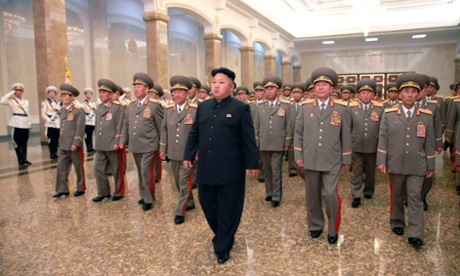
North Korean leader Kim Jong-un (C) visits the Kumsusan Palace of the Sun last week, on the 20th anniversary of the death of  'eternal president' Kim Il-sung.


North Korean leader Kim Jong-un visits the Kumsusan Palace of the Sun last week, on the 20th anniversary of the death of 'eternal president' Kim Il-sung. Photograph: KCNA/Reuters

When the UK’s Foreign and Commonwealth Office released details of its North Korean programme spending this week, some eyes were immediately drawn to the £287.33 the government paid for rights to show the BBC’s Sherlock at the Pyongyang Film Festival in 2012.
Never mind that it had been reported at the time, it got all the attention. But there’s more of interest in the report, which was issued in response to a freedom of information request.
In the last three years, the UK has hosted officials from the North Korean government on seven trips or events.
In 2011 and again in 2012, 10 junior or middle-ranking government officials spent a month in Canterbury studying English and becoming “more aware of British systems, including in areas of media, justice and education.”
Two additional trips in the same years saw three political desk officials from the Ministry of Foreign Affairs come to London to engage on “issues of direct interest” to the UK government, “including human rights and proliferation.”
Three members of the ruling Korea Worker’s Party were also hosted on a visit in 2011, intended to improve understanding of UK’s political system. They met representatives of the three main political parties, the Conservatives, Labour and Liberal Democrats, and the All-Party Parliamentary Group on North Korea in the House of Commons.
In all, more than £95,000 was spent hosting North Korean officials in the UK since 2011, according to the report.
A relatively small £654 was spent to support to visit of North Korean officials from the Institute of Disarmament and Peace to visit theInternational Institute for Strategic Studies in London for a conference on North Korea. Attendance did, according to the report, help improve the DPRK officials understand the "external view of DPRK Weapons of Mass Destruction programmes".
The UK has also funded several initiatives designed to promote the rights and visibility of disabled people in North Korea, including a donation of £3,772 for an athlete to attend a Paralympic Gamesqualifying event in Berlin. It was the first time a North Korean had qualified. Money was also spent to send three athletes to the Asian Youth Para Games, where they came away with three silver medals and a bronze.
Other programmes related to English-language education, health care, women’s rights and energy.
When added together, the UK has spent £724,133 since 2011 on programmes related to North Korea, according to the report. Most of it has gone on English-language education programs.
Here’s the full run-down:

2011 – 2012

£4,578 – a UK hydro-power expert was hosted by the Korean Workers Party in Pyongyang, where he looked at energy developments in the DPRK and gave recommendations for improvement.
£4,608 – food processing equipment was provided to Hoichang, Kumchon and Singye to provide 3,078 children at nurseries, kindergartens and primary school and 230 hospital patients with 100ml soybean milk per day.
£2,075 – sign language training for 30 people in each of Songchon, Hamhung, Pyongsong for one month to improve their ability to use and teach sign language.
£255,721 – British Council’s English Language Teaching and Training Project at Kim Il-sung University, Kim Hyong-jik University and Pyongyang University of Foreign Studies (with £200,000 from the Foreign Office and the rest from the British Council)
£34,735 - visit to the UK by 10 junior/middle ranking officials to study English and learn about British systems, including in areas of media, justice and education.
£6,500 – study visit to the UK by Korean Workers Party officials to learn about the U.K. political system.
£12,605 – visit by DPRK rehabilitation experts and an official from the Korean Federation for the Protection of the Disabled to Stoke Mandeville Hospital to transfer knowledge and understanding about improving spinal cord injury care.
£4,185 – improving access to clean water for children at an orphanage in Pyongsong through provision of a new water pump.
£7,658 – visit by three political desk officers from Pyongyang’s Ministry of Foreign Affairs.
£19,970 – scholarships for two students with leadership potential to attend the University of Cambridge. One studied education and pedagogy, the other studied international law and business administration.
£654 – attendance by North Korean officials at an International Institute for Strategic Studies conference.

2012 – 2013

£202,012 – British Council’s English Language Teaching and Training Project at Kim Il-sung University, Kim Hyong-jik University and Pyongyang University of Foreign Studies (with £200,000 from the Foreign Office and the rest from the British Council)
£3,772 - support for DPRK participation in a Paralympic Games qualifying event in Berlin.
£4,035 – support for vegetable greenhouse production for children in at least 44 institutions of care in Jongpyong and Yonggwang counties, South Hamgyong province, by improving access to a diverse range of vegetables.
£2,383 – provision of two fridges so that 13,108 children in Hamhung and Sinhung would have access to fish outside of production season.
£4,035 – emergency aid of a sanitation system to one primary school, one kindergarten and one nursery school in Singye, North Hwanghae Province.
£37,762 – visit to the UK by 10 junior/middle ranking officials to study English and learn about British systems, including in areas of media, justice and education.
£10,144 – visit by three political desk officers from Pyongyang’s Ministry of Foreign Affairs.
£26,126 – ongoing costs for scholars that arrived in the previous year to the University of Cambridge for studies and return trip home.
£4,092 – greenhouse so 160 children between 5-6 year old in the kindergarten in Samri, South Hwanghae, have year round supply of fresh fruit and vegetables.
£4,296 – provision of teaching aids to 186 students and 85 teachers at blind schools in South Phyongan, South Hamgyong and South Hwanghae.
£6,444 – motorcycles for Songrim Rehabilitation Centre that are driven by 10 disabled riders and provide transport for 800 patients who use rehabilitation per year.
£8,638 – food processing equipment to improve the health and nutritional status of 4,200 families (14,500 people) in Kumchon county.
£8,051 – windmill water pump to provide 160 children between 5-6 year old in the kindergarten in Samri, South Hwanghae, with clean water.
£287.33 – rights to BBC Sherlock Holmes Series British film shown at Pyongyang International Film Festival
£9,218 – assisting international research on implementation of DPRK’s obligations in the area of women’s rights in preparation for North Korea’s Universal Periodic Review and Committee on the Elimination of Discrimination against Women review.
£5,604 – capturing the stories: documenting torture in North Korea. Korean translation of The Torture Reporting Handbook.

2013 – 2014

£14,280 – rehabilitation of hospital water supply system in Singye, North Hwanghae Province, to provide clean water supply and improved sanitation for 270 inpatients and 2700 outpatients per month.
£5,368 – support for three athletes to attend the Asian Youth Para Games in Kuala Lumpur.
£4,164 – funding for a Pyongyang disabled table tennis tournament, which received coverage in local media thus "adds momentum to push for treating disabled as normal members of society and, hopefully, ratification of the UN Convention on the Rights of Persons with Disabilities later this year."

2013 – 2014 (ongoing projects)

£1,674 – security think tank exchange between North Korea’s International Affairs Institute and Royal United Services Institute.
£2,104 – scholarships for two students with leadership potential to attend the University of Cambridge. Both will study international finance and management.
The British Council’s English Language Teaching and Training Project at Kim Il-sung University, Kim Hyong-jik University and Pyongyang University of Foreign Studies. No cost given.
£6,642 – British Council visit to DPRK to plan a future arts workshop and to undertake photography for an exhibit in London in 2014.


____________________________________________
http://www.theguardian.com/world/2014/jul/11/uk-spent-700000-north-korea-programmes?CMP=fb_gu